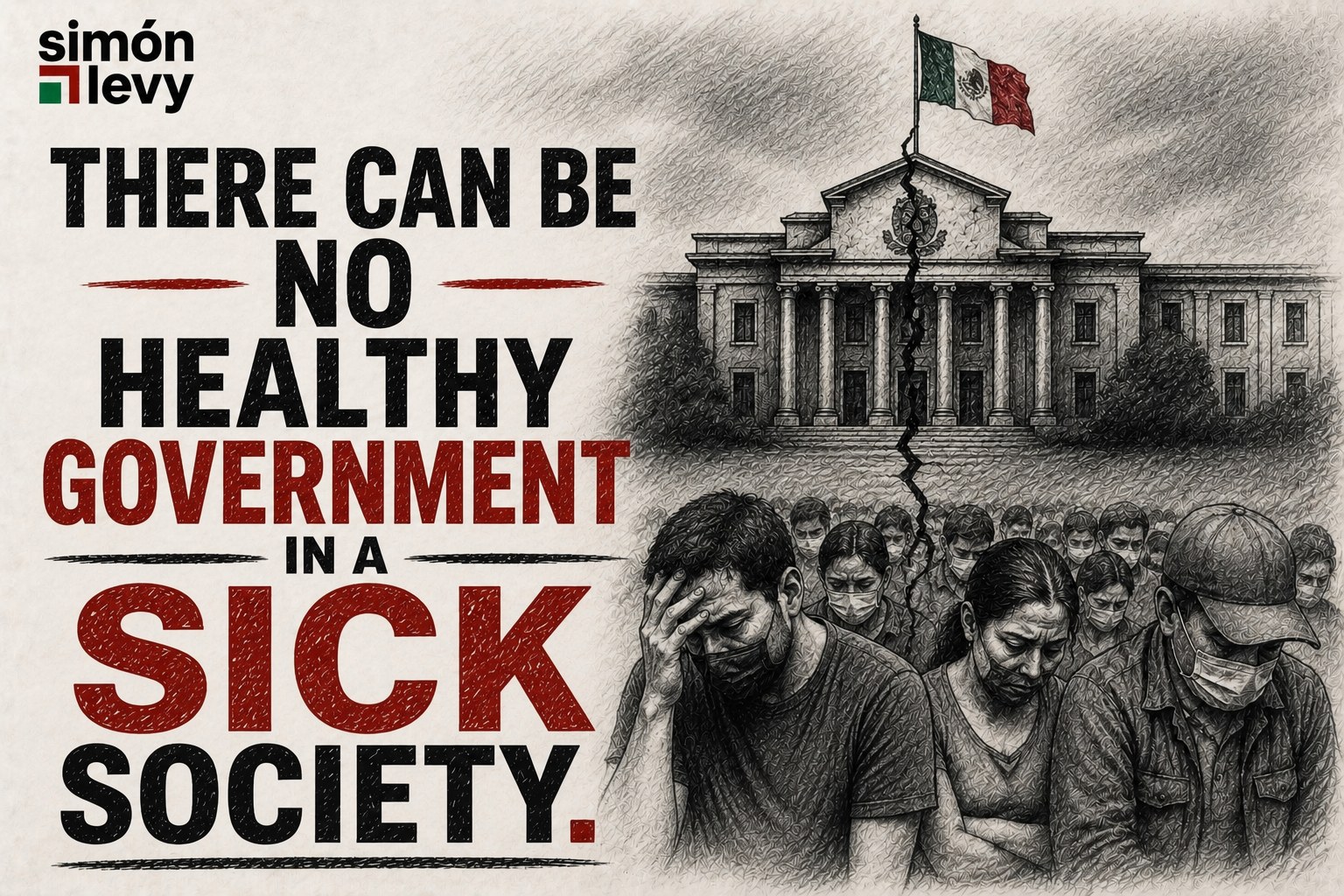

There are phrases that close a debate. Colombian lawyer Santiago Vélez's phrase on the Cepeda vote, published this week on X, is one of them. Not for its elegance. For its clinical precision. In three sentences he describes a collective psychological illness that we have spent forty years describing as ideology, without realizing that ideology is only the symptom. The underlying illness is another. And that illness explains why Petro can negotiate with criminals, dismantle intelligence services and surrender territory, without losing a single vote. And why López Obrador can protect the fiscal huachicol, the Sinaloa Cartel and the financial network running from Beijing to Sinaloa through Houston, without losing a single vote either.
The phrase is this: "They would rather vote for the devil than admit that the right was correct." In that sentence fits half a century of Latin American political history. It fits Cuba after 1959. It fits Venezuela after 1999. It fits Argentina after 2003 and before Milei. It fits Bolivia with Evo. It fits Nicaragua with Ortega. It fits Colombia with Petro. And it fits Mexico with López Obrador. The same illness, eight geographies, thirty years of silent advance. What has enabled the advance is not the strength of the governments. It is the illness of the societies that accept them, tolerate them, reelect them, absolve them. That is why the title of this essay is not rhetorical. It is diagnostic. There can be no healthy government in a sick society. And the society, today, across much of the continent, is sick.
This essay is not about politics. It is about social psychology. About how a loyalty is constructed that survives evidence. About why a rational, literate, informed, urban, professional voter can read in the newspaper that his leader negotiates with the Clan del Golfo or protects the fiscal huachicol, and the following day continue defending him at the family dinner table as if nothing had been read. About the mental machinery that produces that result. And, above all, about why that mental machinery so closely resembles, and this is not a gratuitous analogy, the mental machinery that sustained Hitler until 1945.
I write this with care, because the parallel is serious and because the moral damage of getting it wrong is great. I am not saying that López Obrador or Petro are Hitler. I am saying something else, much more uncomfortable and much more useful. I am saying that the psychological mechanism by which a society comes to tolerate the intolerable is the same in 1933 as in 2026. The contents change. The enemies change. The slogans change. The mechanics do not change.
Ideology is not the illness. Ideology is the symptom. The illness is the inability to admit that one was wrong.
The phrase that explains everything
Vélez says three things in his thread. That the country is anesthetized, that nothing surprises anyone anymore, and that the ideologized voter would rather vote for the devil than admit that the right was correct. Each of those three statements describes a different layer of the same phenomenon. Let us go in parts.
The anesthesia. When a country discovers that its president negotiates with a cartel and the social reaction is a shrug of the shoulders, what that society is showing is not political indifference. It is nervous saturation. It is the same thing that happens to a person who has lived in a house with an unpleasant odor for a year. At first the odor was unbearable. Then they stopped noticing it. Not because the odor disappeared. Because the nervous system, in order to survive, learned not to process it. That, in psychology, is called habituation. It is a normal adaptive function when applied to small stimuli. It is pathological when applied to stimuli of moral magnitude. When a society habituates to news of massacres, clandestine mass graves, alliances between presidents and cartels, what is happening is that the collective moral system is undergoing numbing. Public conscience enters a twilight state. It continues functioning for small matters. It stops functioning for large ones.
The second point is cognitive surrender. Vélez says that nothing surprises anyone anymore. That is not passive resignation. It is an active psychological defense mechanism. When negative stimuli exceed the system's response capacity, the system stops responding, not because it does not feel, but because feeling all the time would equal collapse. The psychologist Martin Seligman baptized it in the seventies as "learned helplessness." His experiments with animals subjected to inescapable negative stimuli showed that after a while the animal stopped trying to escape, even when the cage door was left open. Applied to entire societies, the phenomenon produces citizenries that, faced with repeated evidence of corruption, violence, or complicity, no longer become indignant, no longer mobilize, no longer vote differently. They settle in. They disconnect. That disconnection is the raw material upon which regimes captured by illicit economies build their permanence.
The third point is the deepest of the three and it is the heart of this essay. It is the assertion that there exists a universe of voters for whom admitting that the right was correct is a sin worse than watching one's own government ally with organized crime. That sentence, read carefully, contains a revelation. Politics, for those voters, is not politics. It is religion. And in a religion, admitting that the catechist of the enemy parish was right is apostasy. And apostasy, in a religion, is worse than any sin committed oneself. That is why they would rather vote for the devil. Because voting for the devil is an individual sin, forgivable. Admitting that the right was correct is treason to the faith. And treason to the faith is not forgiven in this world or in the next.
Politics as religion
We have spent centuries confusing two things that are not the same. One is having a political preference. The other is having a political faith. Political preference is reasonable, mobile, adjustable to evidence. I prefer candidate A because his fiscal program seems more sensible to me. If tomorrow I discover that candidate A is allied with a cartel, I withdraw my vote. That is rational politics. That is what democratic theory assumes as the minimum base of the modern voter. And that, across much of the Latin American continent, is exactly what is not happening.
Political faith is another thing. Political faith does not adjust to evidence. Political faith rearranges evidence to make it compatible with the faith. When a faith voter discovers that his president is allied with a cartel, he does not withdraw the vote. He reformulates the information. He says that the cartel is an invention of the opposition. He says that the press reporting it is paid by the right. He says that the dead are fewer than reported. He says that even if it were true, the alternative would be worse. He says anything, except the one thing the evidence demands: change the faith.
Eric Hoffer, the self-taught American philosopher who spent thirty years carrying loads at the port of San Francisco while writing, published in 1951 a brief and decisive little book called The True Believer. In it he described with clinical precision what distinguishes the fanatic from the rational voter. The fanatic, says Hoffer, is not someone who firmly believes in a cause. He is someone who needs to believe in a cause in order not to face himself. The cause is secondary. The function is psychological. That is why a fanatic can move from the most extreme communism to the most extreme nationalism without intermediate transition, as occurred with thousands of German and Russian militants in the thirties and forties. What matters is not the content of the belief. What matters is total surrender to something that exempts one from the work of thinking.
That is what the São Paulo Forum understood and knew how to exploit since its founding in 1990. The political structure that Lula da Silva, Fidel Castro and their operators designed was not a programmatic alliance. It was an alliance of faith. That is why its members most distinct in economic program, from Colombian petrismo to Mexican morenismo through Venezuelan chavismo, speak the same language when it comes to defending the indefensible. They have been formed in the same liturgy. They share the same ritual enemies. They reproduce the same doctrinal body adapted to each geography. And, most importantly, they have produced in their bases the same psychological incapacity to accept that their leaders can be wrong, compromised, or captured.
Politics, for the São Paulo Forum voter, is not politics. It is secularized religion. And that explains why evidence does not work. Because religions are not refuted with evidence. They are refuted with apostasy. And apostasy is the only thing that the believer's brain cannot execute without disintegrating.
The factory of faith
It is worth asking how that faith is constructed. It is not born alone. It is not natural. It is manufactured. And the method of manufacture has a technical name. It is called ideologization. And ideologization, before being a political instrument, is a psychological operation.
The method has four steps. It has worked in Cuba since 1959, it has worked in Venezuela since 2000, it has worked in Colombia since 2010, and it has worked in Mexico since 2006. It worked in Germany between 1923 and 1945. It works in any society where it is applied with discipline and sufficient time.
First step. A real historical grievance is identified. This is important. Ideologization is not built on lies. It is built on partial truths exaggerated until they become frameworks of total comprehension. In Germany, the grievance was Versailles. In Cuba, it was the Batista dictatorship and dependence on the United States. In Venezuela, it was the Punto Fijo elite pacts. In Colombia, it was the historical classism of the savanna against the peasantry. In Mexico, it was the neoliberal governments and the corruption of the PRIAN. All those grievances are real. All contain truth. The trick is not in inventing them. It is in exaggerating them until they become the sole explanation.
Second step. A clear and permanent enemy is constructed. The enemy is not a person. It is a category. In Germany it was the Jew. In Cuba it was the "worm." In Venezuela it was the "oligarchy." In Colombia it was the "ultra-right." In Mexico it is the "fifí." The enemy fulfills three psychological functions. It cohesively binds the in-group against a sharply defined outside. It explains all failures without need for self-criticism. And, above all, it exempts the believer from the effort of thinking. When everything bad is explained by the enemy, analysis is no longer required. Only loyalty is required.
Third step. Its own language is constructed. This is what Victor Klemperer, the German Jewish philologist who survived Nazism hidden in Dresden, called "LTI," the Lingua Tertii Imperii, the language of the Third Reich. Klemperer demonstrated in his 1947 book that Nazism was not, first of all, a political project. It was, first of all, a linguistic project. Before killing Jews, the Nazis changed the words with which Jews could be thought. Before invading Poland, they changed the words with which Poland could be thought. The regime first captured the language, and the mind followed afterward. The São Paulo Forum did the same. "People" ceased being a neutral sociological category and became a synonym for the in-group voter. "Conservative" ceased meaning what it meant in classical political theory and came to designate the enemy. "Neoliberal" became a synonym for universal villain applicable to any person, policy, or measure that was not of the party. "Progressivism" installed itself as a synonym for virtue, without anyone being able to explain exactly what progress, nor toward what. That is the capture of language. And whoever controls language controls the possibility of thinking differently.
Fourth step. Belonging is ritualized. In all São Paulo Forum projects there are weekly or daily rituals that fulfill ecclesiastical functions. López Obrador's morning press conference was not information. It was mass. The Bolivarian broadcast of Chávez and later of Maduro is not information. It is liturgy. The marches, the plaza events, the revolutionary anniversaries, the speeches repeated without variation for years, all of that reproduces the functions of an institutional religion: cohesion, repetition, common identity, emotional reinforcement, hostility against the outsider. The true believer, said Hoffer, does not need arguments. He needs rituals. And the São Paulo Forum understood that with professional precision.
Before killing Jews, the Nazis changed the words with which Jews could be thought. Before protecting the fiscal huachicol, López Obrador changed the words with which the fiscal huachicol could be thought.
From Goebbels to São Paulo
Joseph Goebbels, propaganda minister of the Third Reich between 1933 and 1945, left written several operational principles that today are taught in schools of political communication without almost anyone naming their origin. One of those principles is known as the "principle of repetition." Goebbels formulated it more or less thus: a lie repeated a thousand times becomes truth. The phrase is so cited that it has lost force. It is worth returning weight to it. What Goebbels was describing, in contemporary psychological terms, is what we today call the "illusory truth effect." It is a cognitive bias perfectly documented in scientific literature since the experiments of Hasher, Goldstein, and Toppino in 1977. The conclusion, demonstrated hundreds of times since then, is that the human brain confuses familiarity with veracity. A statement that we hear repeatedly, even when we know rationally that it is false, begins to feel true. Not because it is. Because repetition makes it familiar, and familiarity activates the same neurological circuits that truth activates.
Goebbels intuited it. Science confirmed it. And the São Paulo Forum operators industrialized it. The phrase "conservatives are those of the past" is not an argument. It is a repetition. The phrase "failed neoliberalism" is not an analysis. It is a repetition. The phrase "imperialist United States" is not a thesis. It is a repetition. Repeated for thirty years, in school textbooks, in morning conferences, in weekly columns, in national broadcasts, in coordinated social networks, these repetitions produce in much of the Latin American population what repeated prayers produce in devotees: unmovable certainty. Certainty does not come from evidence. It comes from repetition. And evidence, when it arrives, is no longer processed as evidence. It is processed as enemy provocation.
There is a second Goebbelsian principle worth rescuing. It is the principle of simplification. All effective propaganda, said Goebbels, must reduce the message to a handful of elementary ideas and hammer them until exhaustion. Complexity is the enemy of mass persuasion. Subtlety is the enemy of loyalty. The human nervous system, subjected to daily stress and informational overload, prefers simple narratives to complex explanations. That is why populism always wins the first stretch. Because it offers a three-line explanation for five-hundred-page problems. And the three-line explanation, even if false, wins because it enters the brain without friction. The five-hundred-page explanation, even if true, loses because it demands cognitive effort.
Applied to the Latin American continent, that means the following. If I try to explain to the average Mexican voter why the fiscal huachicol is a criminal operation that damages the country, I need to speak to him about Section 311 of the Patriot Act, OFAC, SAR-FinCEN cooperation, Chinese chemical precursors, the Southern District of Texas, the migrant file. That is five minutes of sustained attention and technical vocabulary. If López Obrador, on the other hand, says "it is a plot of the conservative right to destroy the fourth transformation," that is ten seconds. And the ten seconds win, every day, against the five minutes. Until society trains itself to accept only the ten seconds. And then it ceases to be available for the five minutes. And then the very possibility of thinking politically has been lost.
The anesthetized street
Vélez said that the country is anesthetized. That word, anesthesia, is medical. It designates a state in which the organism conserves vital functions but loses the capacity to feel pain. Anesthesia is good in an operating room. It is terrible in a society. Because an anesthetized society conserves functions, votes, works, consumes, pays taxes, but has lost the capacity to register pain. And without the registration of pain, no system corrects the damage. The system simply absorbs it, metabolizes it, normalizes it.
The process of social anesthesia has several simultaneous sources worth naming so as not to remain in metaphor. The first source is informational saturation. We live in an era in which average daily exposure to negative news is between thirty and fifty times greater than in the nineteen-eighties. The capacity of the human limbic system to emotionally process that quantity of stimuli never existed. That is why the brain defends itself as it can, distancing itself affectively from the content. It reads it, but no longer feels it.
The second source is what social psychology calls "compassion fatigue." Initially documented among emergency physicians and humanitarian workers, today we know it also occurs at the population scale. A society subjected for a decade to news of massacres, mass graves, disappearances, criminal alliances, narco-politicians, gradually loses the capacity to respond emotionally to each new episode. Not because it is cynical. Because its empathy mechanisms have been exhausted. What in the nineteen-eighties would have produced a march of two hundred thousand people in the Zócalo or in Bolívar Square, today produces an indignant tweet that lasts four hours in trending and is forgotten the next day.
The third source is the institutional capture of the spaces that historically awakened civic indignation. When independent media is reduced to a fraction of what it was, when universities reproduce the language of the regime without nuance, when public intellectuals are co-opted, bought, or silenced, when NGOs that previously denounced abuses today receive budget from the denounced government, when bishops keep silent so as not to lose political space, the social circuits through which indignation previously circulated become clogged. And indignation, without channels, becomes private frustration. Private frustration, in turn, does not produce a different vote. It produces abstention, emigration, or resignation.
The fourth source, the most sophisticated of the four, is the capture of moral language. When the regime achieves that the word "denunciation" is automatically associated with "disloyalty," when it achieves that the word "investigation" is equated with "attack," when it manages to have telling the truth about a crime presented as treason to the project, society loses the basic semantic apparatus with which abuses are processed. It is not that there is no information. It is that information, when it arrives, no longer has mental categories in which to accommodate itself. It falls into the void. And society continues functioning without knowing that it is sick.
The unforgivable sin
We arrive at the center of the phenomenon. Vélez's phrase about the unforgivable sin. He says that for the ideologized voter, admitting that the right was correct is a sin worse than seeing one's own government ally with criminals. That mental structure has a technical name in social psychology. It is called "cognitive dissonance." The term was coined by Leon Festinger in his 1957 book A Theory of Cognitive Dissonance, and it describes what occurs when a person faces evidence that deeply contradicts his previous beliefs.
Festinger demonstrated that the human mind, faced with that contradiction, does not process the evidence and change the belief, as rational theory would predict. It does the opposite. It rearranges reality so that the belief survives. And the deeper the initial belief, the more radical the rearrangement. His best-known experiment was with an apocalyptic sect that predicted the end of the world for a specific date. When the date passed without apocalypse, the members did not abandon the sect. They reinforced their faith. They began to proselytize. They convinced more people. Because admitting that they had been wrong for years would have been psychologically more devastating than sustaining the doctrine against all evidence.
That is what occurs with the ideologized voter of the São Paulo Forum. If he admits that López Obrador protected the fiscal huachicol, he does not admit only that. He admits that for six years, at family dinners, in table talks with friends, in network discussions, he defended something that was false. He admits that the people he called "fifís," "sellouts," "neoliberals," were partially right. He admits that the emotional cost of six years of militant identity was spent defending the indefensible. That is much cost. It is a cost that the mind, through perfectly normal mechanisms common to every person, prefers not to pay. And in order not to pay it, it does something astonishing. It rearranges the evidence. It finds excuses. It attributes the information to plots. It changes the subject. It accuses whoever presents the facts of "moralism," "criminalization," "instrumentalization." It does anything, except the one thing rationality would require: change position.
That is why they would rather vote for the devil. Not because they love the devil. Because loving the devil costs less psychologically than admitting, before the mirror, that for a decade they were used as emotional infantry of a project that ended up marrying crime. Vélez's phrase does not describe evil. It describes fear. The deepest fear of the human being. The fear of having been the useful fool. Before admitting that, almost any person prefers to believe anything.
They do not prefer the devil out of evil. They prefer the devil out of pride. Pride is the last fortress of the wounded ego, and the wounded ego does not surrender even when the house is burning.
The marriage with crime
There is a question worth formulating with candor. Why do the São Paulo Forum projects, in all their national variants, invariably end up allying with organized crime? It is not accident. It is not circumstantial weakness. It is structure. And it is worth understanding why.
A political project sustained by ideological loyalty and not by material performance needs two things to survive in the long term. The first is to continue producing enemies. The second is to count on economic resources parallel to those of the formal State, because the formal State, governed under doctrines of aggressive redistribution, tends to produce fiscal crises, capital flight, economic contraction. When the formal coffers of the State empty, the project needs to finance itself through alternative channels. And the available alternative channels, in countries with large illicit economies, are obvious.
That is the formula repeated in each geography. Cuba sustained itself for decades with Soviet money and, after 1991, with parallel economy linked to networks in Venezuela, Angola, and other gray zones. Venezuela sustained itself with the capture of state oil and, when oil collapsed, with the integration of military operators in the hemispheric drug trade today known as the Cartel of the Suns. Nicaragua sustains itself with Russian, Chinese, and Iranian flows mixed with laundering operations documented by OFAC. Bolivia sustained itself for years with capture of lithium and coca. Colombia, with Petro, has seen the government formally negotiate with the Clan del Golfo, with the ELN, with FARC dissidents, in frameworks of "total peace" that in practice are territorial legitimizations of criminal networks. And Mexico, with López Obrador and Sheinbaum, has articulated the fiscal huachicol documented in the Southern District of Texas, the shielding of the Sinaloa Cartel exposed by SDNY, and the financial network with banks sanctioned by FinCEN.
In all cases the pattern is identical. The project needs financing. The formal economy does not give it. The illicit economy gives it. The project, in order to preserve its financing, must protect the illicit economy. And in order to protect the illicit economy, it must convince its electoral base that the illicit economy does not exist, or that it exists but is an opposition plot, or that it exists but is a lesser evil compared to the neoliberal alternative. And the electoral base, ideologized for years by the mechanisms described in previous chapters, is prepared to accept any of those three explanations. Because admitting the contrary would equal apostasy. And apostasy is the unforgivable sin.
The circle closes thus. Ideologization produces loyalty. Loyalty enables the marriage with crime. The marriage with crime requires more ideologization to sustain itself. Ideologization reinforces loyalty. And the cycle repeats until the entire country, without realizing it, has been delivered to an architecture where the State and crime are the same thing with two different names. It happened in Cuba. It happened in Venezuela. It is happening in Nicaragua. It is beginning to happen in Colombia. It has been happening for seven years in Mexico.
Mexico as mirror
Whoever reads these pages thinking of Petro will have read them from Bogotá. But the proof that the diagnosis is not local but structural is obtained by changing the names and leaving the rest identical. Change Petro for López Obrador. Change Cepeda for Sheinbaum. Change Clan del Golfo for Sinaloa Cartel. Change total peace for humanistic security. Change Pacto Histórico for Morena. Change Caracol's investigation into the Clan del Golfo for designations by the Southern District of New York against Rocha Moya, Mérida Sánchez, Díaz Vega, and seven more cadres. The text continues working word for word. Because the illness is the same.
The average Mexican voter who defended López Obrador during the six-year term did not defend him by evidence. He defended him by faith. When the videos appeared of the former president's brothers receiving bags with money, the faith voter did not rearrange his vote. He rearranged reality. He said that the video was manipulation. He said that the amount was lesser. He said that any politician would have done it. He said that the difference is that López Obrador did not steal for himself. When the fiscal huachicol network was revealed in the Southern District of Texas, the faith voter said that it was U.S. interference. When the migrant Census data clashed with the official remittance figure of twenty-one billion dollars annually unexplained, the faith voter said that it was neoliberal propaganda. When Sheinbaum protected Adán Augusto, Mario Delgado, Andy López Beltrán, Américo Villarreal, Marina del Pilar, the faith voter said that it was political persecution. When Secretary Mullin delivered nine individual extradition files in May 2026, the faith voter said that it was a violation of sovereignty.
Each explanation is dissonant with the next. Accumulation makes them all unsustainable together. But the faith voter does not sum them. He uses them separately, one for each occasion, without noticing that the complete list configures an architecture of excuses that no other Mexican six-year term could have assembled without collapse. The reason he does not sum them is cognitive dissonance. Summing them would equal realizing. And realizing is the one thing that the ideologized mind cannot allow itself.
Mexico today lives what Germany lived in 1938. The majority of the population did not know exactly what was happening, but knew enough to know that something was happening. And the majority preferred not to know it. Hannah Arendt, in her book Eichmann in Jerusalem published in 1963, described it with the phrase that would make her famous: "the banality of evil." What Arendt saw in Eichmann was not a monster. He was a bureaucrat. A functionary who complied with orders, asked no questions, did not think beyond his desk. The terrible thing was not that Eichmann was evil. It was that he was ordinary. And that ordinariness, multiplied by millions of similar functionaries and citizens, was what made Auschwitz possible. Evil does not need demons. It needs ordinary people who prefer not to think.
That same ordinariness is today in many Mexican homes. Not of evil people. Of ordinary people. Professionals, employees, retirees, youth, mothers, professors. People who in another context would be the pillars of a functional democracy. But who have been subjected for seven years to the combination of four steps described in Chapter III. They have been ideologized. And ideologization has converted them into emotional infantry of a project that married crime, without them fully realizing it.
The cure is not political
If the illness were political, the cure would be political. But the illness is not political. The illness is psychological, anthropological, cultural. That is why the cure is not political either. The cure is the slow reconstruction of the citizen's capacity to think against one's own tribe.
That capacity is called, in classical philosophy, parrhesia. Parrhesia is the disposition to tell the truth even when the truth costs. It is what Socrates exercised in Athens until they condemned him to death. It is what the Old Testament prophets exercised against their own kings. It is what Russian intellectuals in exile exercised against Bolshevism. It is what Václav Havel exercised against Czechoslovak communism. It is what the Latin American citizen requires, today, to begin curing himself of the illness described in this essay.
Parrhesia begins in private. It begins at the family dinner table when one dares to say that the president for whom one voted three times may have committed serious errors, without expecting the applause of the table. It begins in the conversation with the lifelong friend when one dares to admit that the person called "fifí" for years may have been right on some points. It begins in the WhatsApp group when one dares to share a note critical of officialdom without fearing expulsion from the group. Those gestures seem minor. They are not. They are the gestures where the social immune system that ideologization destroyed is reconstructed, cell by cell.
The second step is reading. Ideologization is sustained in simplification. The cure begins with complexity. Returning to reading whole books, not summaries. Returning to the sources, not to the memes. Returning to the press that documents, not to the press that opines. Returning to the universities that teach how to think, not to those that teach how to militate. Long reading is the natural antidote to short propaganda. That is why short propaganda always tries to displace long reading. That is why whoever wants to cure himself, individually or collectively, must reincorporate long reading into his cognitive diet.
The third step is recognition. Accepting that one was wrong on some point. Not on everything. Total repentance is not necessary. It suffices to admit, in some conversation, that at some moment one sustained a position that subsequent evidence has shown unsustainable. That gesture, apparently small, is the most difficult of all. Because it breaks the spell. Because it demonstrates to the brain that it can survive the act of admitting an error. And from that moment, the brain becomes available for future corrections. Parrhesia begins with a single act of honesty with oneself. Then it branches.
The fourth step, the deepest, is the most difficult. It is accepting that no government, no ideology, no cause deserves the absolute surrender of one's own conscience. That surrender is the raw material of all twentieth-century totalitarianisms and of all twenty-first-century São Paulo Forum projects. Conscience, in a free person, is not yielded. It is administered with care. It is trained to discriminate between the true and the false, between the just and the unjust, between the good and the bad, without any party, any caudillo, any morning briefing, any dogma holding the key to that discrimination. That moral autonomy is the basic psychological health of the democratic citizen. It is what ideologization destroys. And it is what must be reconstructed, piece by piece, in every home, in every conversation, in every private act of honesty with oneself.
There can be no healthy government in a sick society. The cure does not come through the vote. The cure comes through conscience.
That is why this essay does not end with a political recommendation. It ends with a moral invitation. The invitation is to recover parrhesia. To return to telling the truth even when the truth costs. To stop preferring the devil only so as not to admit that the catechist of the enemy parish had some valid points. To understand that personal dignity is worth more than tribal cohesion. To accept that being a free citizen costs more than being a comfortable fanatic. But that only of the first are habitable republics built.
If at some moment, in some conversation, someone who has sustained São Paulo Forum positions for years dares to say in a low voice, before his own mirror, that perhaps on some things he was wrong, at that moment the cure begins. Not the cure of the country. The cure of the citizen. And only the cure of the citizen produces, afterward, the cure of the country. In the inverse order it never worked. In the correct order, patient and slow, it worked in postwar Germany, it worked in post-fascist Italy, it worked in post-Francoist Spain, it worked in post-communist Eastern Europe. It will also work in Latin America, but only when enough citizens, individually, begin to permit themselves apostasy.
Apostasy, in religious language, is a sin. In the language of sick societies, also. But in the language of free societies, apostasy regarding the dogmas that have made us sick is not a sin. It is the first act of health. The most difficult. The most fecund. The one that cures.
We need to believe again that thinking against the tribe is an act of love, not of treason. We need to understand again that admitting that the other was right about something does not diminish us, it enlarges us. We need to stop measuring personal dignity by unconditional loyalty to a political project and begin measuring it by the coherence between what one says, what one thinks, and what one does.
The day that enough people, in enough homes, begin that private exercise of honesty, the sick governments will lose their raw material. There will be no more voters willing to defend the indefensible. There will be no more consciences for rent. There will be no more emotional infantry for the machineries of blind loyalty. And then, only then, can the reconstruction of the continent begin.
Until that day, I will repeat the phrase with which this essay opens, and with which it closes. There can be no healthy government in a sick society. The cure is not political. The cure is moral. And the moral begins with oneself, before the mirror, on any morning, when one dares for the first time to admit that perhaps one was wrong.
This essay was born from reading a thread published on X by Colombian lawyer Santiago Vélez (@santiagovelezp) the last week of June 2026, regarding the Colombian runoff and Caracol's investigation into the Clan del Golfo. Vélez's phrase —"they would rather vote for the devil than admit that the right was correct"— is the exact point from which these pages were constructed. My acknowledgment to Vélez for having said, in few words, what many analysts do not dare to name, and for having opened, with his clinical precision, the possibility of a continental psychological analysis that surpasses the limits of the Colombian case.
This essay combines verifiable empirical observations on contemporary Latin American political psychology with references to classical literature in social psychology (Festinger, Hoffer, Seligman, Klemperer, Arendt) and to historical propagandistic doctrine (Goebbels). The parallel between the mechanisms of the Third Reich and those of the São Paulo Forum refers exclusively to the psychological mechanics of producing ideological loyalty, not to the moral or factual content of the political projects compared. All historical references are available in public archive. The interpretive responsibility of the whole is the author's.